
Understanding USB Type-C
USB Type-C combines a reversible connection with support for a range of data, power and optional non-USB functions. Terms such as Alternate Mode, Accessory Mode, Structured VDM and Unstructured VDM describe how those additional functions are negotiated. This archived article explains the technology and the components involved in system design. Original source: http://www.eepw.com.cn/article/284329.htm.
Power, symmetry and bandwidth
Type-C provides default 5 V USB power and includes four power pins and four ground pins. Under the Power Delivery specification discussed in the article, compatible systems can negotiate up to 20 V and 5 A. The connection is symmetric: a plug can be inserted either way up, and a Type-C cable can have the same connector at both ends. Connected hardware determines the functional roles.
Type-C systems can implement USB 2.0, USB 3.1 Gen 1 at 5 Gbit/s, or USB 3.1 Gen 2 at 10 Gbit/s. USB 2.0 and USB 3.1 are defined by separate specifications. SuperSpeed differential pairs are arranged on both sides of the connector so a suitable pair is available in either orientation.
Channel configuration and non-USB signals
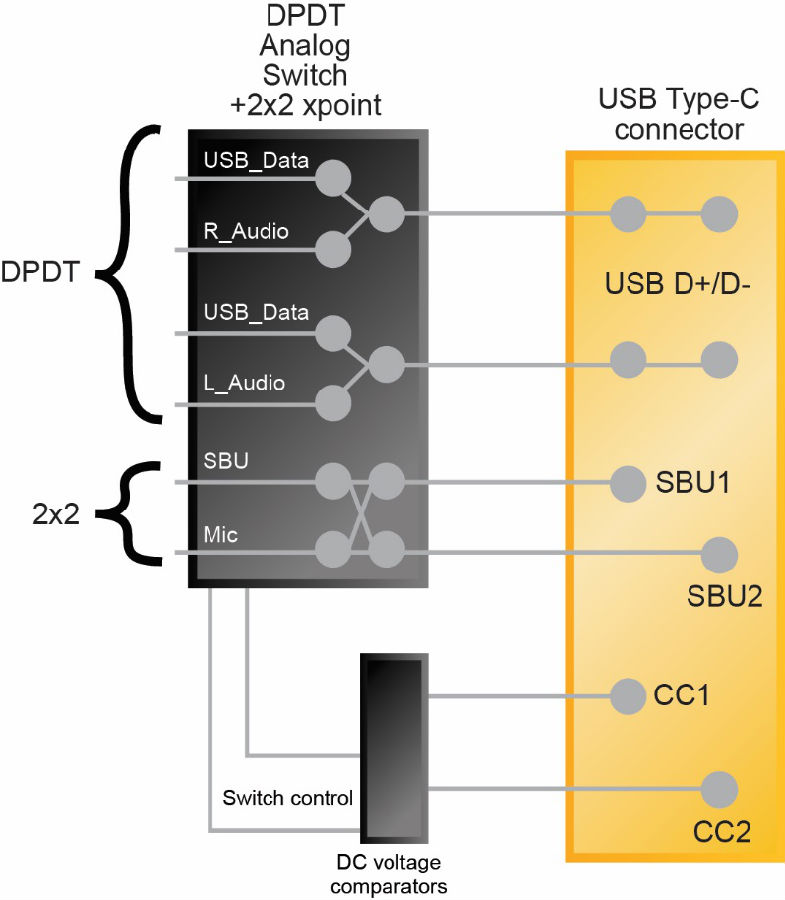
Two configuration-channel pins, CC1 and CC2, help determine orientation and negotiate power, alternate modes and accessory modes. Certain pins can be reassigned for additional signals over a full-featured Type-C cable; other pins may be used in direct-connect applications.
The CC channel coordinates those assignments. Accessory mode uses logic detection, while alternate-mode negotiation uses bidirectional Biphase Mark Coding. Both ends must agree before reassigning signals. A Type-C port must retain its appropriate USB behavior outside the optional modes it implements.
Accessory modes
The article describes analog audio and debug accessory modes. In an analog audio implementation, the USB 2.0 D+ and D− pins can carry left and right audio, with an SBU sideband pin carrying a microphone signal. Support is implementation dependent. The original article also discusses anticipated digital-audio development.
Alternate modes
Alternate modes allow some Type-C signal paths to carry another interface. The standardized examples discussed include DisplayPort and MHL, developed by their respective standards organizations. Vendors may also define proprietary modes. Support for one mode does not imply support for another, so users should check the specifications of the source device, cable, adapter and display.
DisplayPort configurations can assign different numbers of lanes to video, trading available video bandwidth against simultaneous SuperSpeed USB operation. The article discusses compressed and uncompressed video and resolutions supported by the applicable DisplayPort versions. MHL likewise defines its own video and control requirements.
Vendor-defined messages
Structured and unstructured Vendor Defined Messages (VDMs) operate through USB Power Delivery. Structured messages provide mechanisms used to discover, enter, manage and exit alternate modes. Unstructured messages provide vendor-specific communication for functions that do not fit the structured command set. System designers need compatible chipsets and negotiation controllers for the modes they intend to support.
Power negotiation
Power Data Objects describe voltage and current capabilities. The supplying device advertises available power options, the receiving device chooses a suitable option, and the devices establish a power contract before changing the power level. Supported combinations depend on both devices and the cable. Backward compatibility is preserved, but higher-power functions are optional.
Consumer and system-design considerations
The Type-C connector form does not guarantee a particular data rate, video mode or charging level. Documentation should be checked to avoid connecting accessories that use incompatible optional modes. Fast charging requires compatible voltage and current capabilities at both ends. Designers must select suitable interface chipsets, mode-negotiation devices and cables. The article cites Lattice controllers as an example from its original publication period.


Previous Cable classifications
Next Cable construction